Dando presencia a las ausencias/ On Giving Presence to the Absences
Dando presencia a las ausencias
Apuntes sobre el Manuel Calvo, los expulsados y la ética de llenar los vacíos
Hay silencios en los archivos que provienen de la pérdida, y otros que nacen de la necesidad.
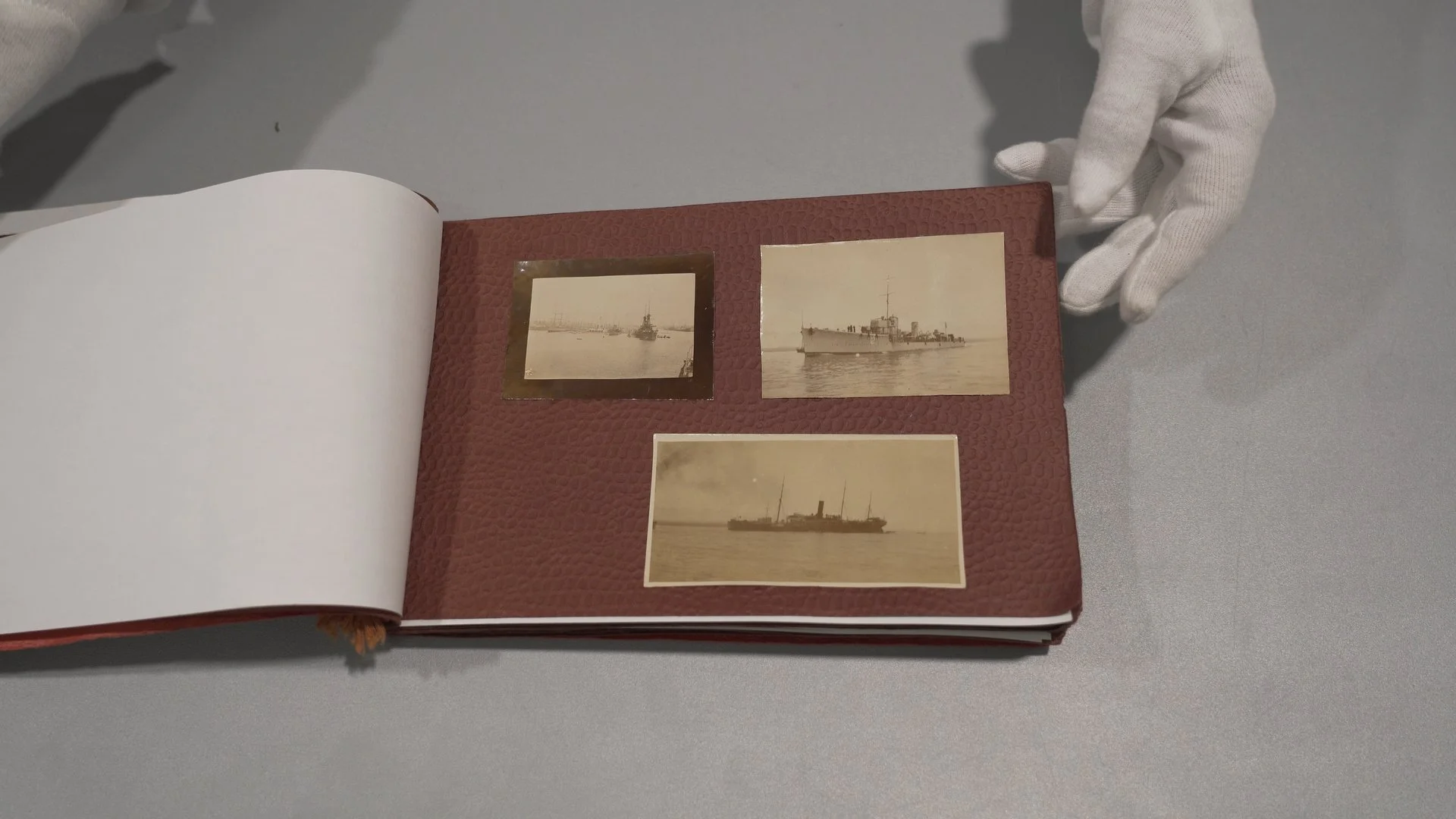
El álbum del Manuel Calvo pertenece a los segundos.
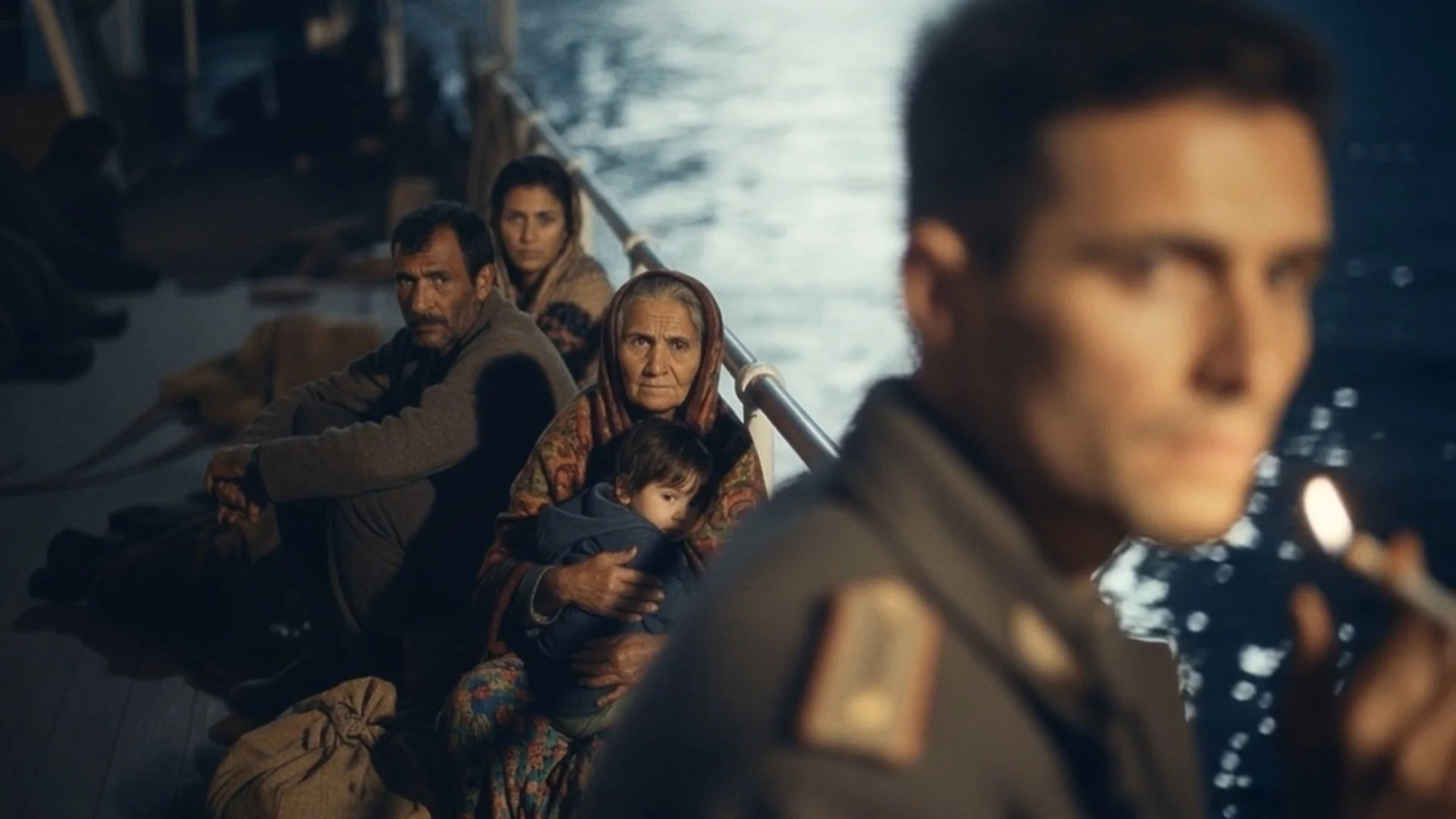
Las fotografías fueron tomadas en marzo de 1919 por el médico del barco. Muestran la salida de Barcelona, los rostros de los expulsados —rusos, turcos, bosnios, búlgaros, armenios, judíos sefardíes— y algunos destellos mínimos de la vida cotidiana a bordo. Cubiertas, cuerpos en reposo, instantes en los que el tiempo parece suspendido en mitad del mar.
Y entonces, casi de forma abrupta, las imágenes se interrumpen.
No porque la historia termine, sino porque la cámara lo hace.
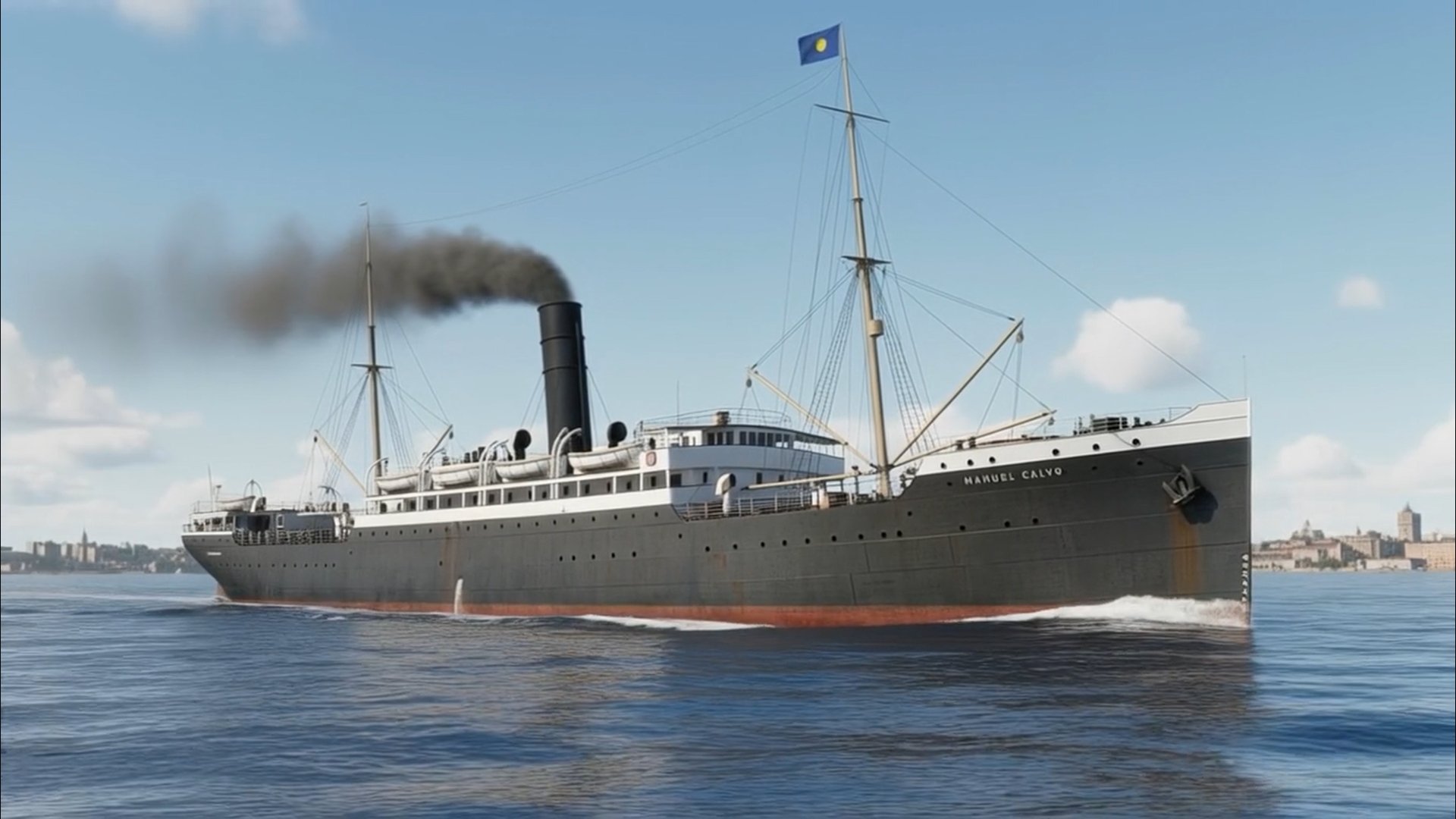
Tras la explosión de la mina cerca de Ténedos —el momento que marcaría definitivamente el viaje— el álbum contiene solo una fotografía tomada aún en el mar: el Manuel Calvo escorado, herido, junto al buque de rescate. Después vienen las imágenes del dique seco en Constantinopla: el casco desgarrado, las vigas fracturadas, los hombres trabajando para reparar lo reparable. Y, finalmente, algunas vistas de la tripulación esperando, atrapada en un tiempo suspendido mientras el barco vuelve a ser navegable.
Entre esos momentos se abre un gran vacío.
Como fotógrafo, ese silencio me resulta profundamente elocuente. El médico no dejó de fotografiar por desinterés ni por olvido, sino porque su lugar había cambiado. Tras la explosión, la fotografía dejó de ser prioritaria. Había cuerpos que atender, heridas que cerrar, vidas que sostener. La cámara guardó silencio porque la responsabilidad ocupó su lugar.
Ese silencio no es una ausencia.
Es una forma de testimonio.
La petición del museo era sencilla: convertir este álbum frágil —imposible de exponer— en una pequeña proyección digital para un rincón de la exposición permanente. Un gesto de conservación. Una forma de mantener visible el objeto sin dañarlo.
Pero al trabajar con las imágenes sentí que el álbum pedía algo más delicado. No más ruido. No más explicación. Solo más espacio a su alrededor.
Siempre he sido cauteloso con la forma en que la inteligencia artificial promete “revivir el pasado”. Con demasiada frecuencia sustituye el silencio por espectáculo, la duda por certeza. Pero aquí, frente a un archivo roto por la necesidad, me pregunté si la herramienta podía usarse de otro modo: no para rellenar lo que falta, sino para reconocerlo.
Las primeras pruebas fueron mínimas: una animación muy sutil de dos fotografías. Pedí que se mantuviera el grano, el contraste, la degradación del papel; que la imagen siguiera anclada a su tiempo material. El movimiento era casi imperceptible, más respiración que gesto. El resultado me sorprendió. No modernizaba la imagen. Me permitía habitarla un poco más.
Ahí el proyecto cambió.
Tenía tres semanas.
Veintiún días para investigar un barco del que apenas existen imágenes, para comprender un contexto político deliberadamente olvidado, para estudiar uniformes, tejidos, construcción naval y la geografía de un mar que, meses después del final oficial de la guerra, seguía sembrado de minas.
La mayor parte de la investigación fue visual. A través del museo accedí a fotografías del Manuel Calvo tomadas tras la explosión, ya en dique seco. En ellas la violencia aparece sin dramatismo: la forma del boquete, el acero rasgado, la escala real del daño. Leí artículos de prensa de la época, escasos y cautelosos, condicionados por la inestabilidad política y el silencio institucional.
Algunas reconstrucciones eran posibles. Otras no.
Intenté recrear la sala de máquinas a partir de planos técnicos y referencias de vapores similares, pero nada terminaba de sostenerse. Sin documentación suficiente, las imágenes derivaban hacia la especulación. Decidí descartarlas todas. No todo debe mostrarse. El vacío, cuando se respeta, también pesa.
Las figuras que aparecen en las escenas generadas parten del propio álbum: rostros, siluetas, posturas, uniformes. Cuando fue necesario crear personajes secundarios, investigué la indumentaria, los tejidos y las texturas de la época, y los situé únicamente en espacios históricamente validados. Cada imagen fue generada, comparada, rechazada y afinada. La inteligencia artificial no marcó el camino; lo siguió.
A menudo hablo en plural por costumbre, pero este fue un trabajo solitario. Las decisiones, las dudas, las renuncias —todas pasaron por mis manos.
El momento más difícil de abordar fue la explosión.
Las minas navales no se comportan como el cine. Su violencia es seca, vertical, desorientadora. Las imágenes de archivo muestran el después con crudeza, pero no el instante mismo. Omitirlo por completo habría sido deshonesto. Recrearlo con exceso, obsceno.
Estudié textos de ingeniería naval, material documental sobre explosiones submarinas, relatos de supervivientes y las fotografías tomadas tras el rescate. Decenas de intentos fueron descartados: demasiado espectaculares, demasiado limpias, demasiado seguras de sí mismas.
Al final permití que el suceso apareciera solo de forma breve, en dos planos contenidos. Uno lejano: agua y humo elevándose. Otro a nivel de cubierta: confusión, desequilibrio, miedo. Sin insistencia. Sin énfasis. No una recreación, sino un eco.
A veces, la forma más ética de mostrar algo es dejar que pase rápido.
La pieza final es breve —un minuto y medio— y silenciosa. Se proyecta en bucle, sin sonido ni instrucciones. Las fotografías originales son su núcleo. Todo lo demás existe para crear transiciones, para no depender únicamente del efecto parallax, para dar ritmo a una historia hecha de fragmentos.
El viaje que recorre es trágico. Ciento cinco personas murieron cuando el Manuel Calvo chocó con la mina. Quienes sobrevivieron fueron desembarcados en Constantinopla y abandonados sin protección ni apoyo. El barco fue reparado. Las personas no.
El equipo del museo ha recibido la pieza con una cercanía que agradezco. Reconocen —creo— que no se trata de una exhibición tecnológica, sino de un ejercicio de escucha: al archivo, a sus silencios, a la ética que habita en lo que no fue fotografiado.
Este proyecto ha modificado mi relación con las herramientas generativas. Ya no las veo únicamente como una intrusión, sino como instrumentos que, bajo un control estricto, pueden extender los bordes de un relato sin pretender completarlo. Forman parte de mi caja de herramientas, sí, pero no sustituyen a la realidad.
Mi ancla sigue siendo lo real.
Pero algunas historias exigen un lenguaje capaz de moverse con cuidado entre lo visto, lo vivido y lo que tuvo que quedar sin registrar.
La cámara guardó silencio porque el cuidado tomó el relevo.
Honrar ese silencio fue, para mí, el único lugar desde el que empezar.
On Giving Presence to the Absences
Notes on the Manuel Calvo, the expulsados, and the ethics of filling the gaps
There are silences in archives that come from loss, and others that come from necessity. The album of the Manuel Calvo belongs to the second kind.
The photographs were taken in March 1919 by the ship’s doctor. They show the departure from Barcelona, the faces of the expelled nationals — Russians, Turks, Bosnians, Bulgarians, Armenians, Sephardic Jews — and a handful of modest glimpses into daily life aboard. Decks, postures, moments where time seems briefly suspended at sea.
Then, almost abruptly, the images stop.
Not because the story ends, but because the camera does.
After the mine explosion near Tenedos — the moment that would define the voyage — the album contains only one image taken at sea: the Manuel Calvo listing, already wounded, alongside the rescue vessel. After that come photographs from dry dock in Constantinople: the torn hull, the fractured beams, men at work repairing what can be repaired. And finally, a few images of the crew waiting, inhabiting a suspended time while the ship is made seaworthy again.
Between these moments lies a wide silence.
For me, as a photographer, that silence feels deliberate. The doctor did not stop photographing because the event lacked importance, but because his attention had shifted elsewhere. In the aftermath of the explosion, photography was no longer a priority. Bodies needed care. Wounds needed tending. Lives demanded presence. The camera fell silent because responsibility took its place.
That silence is not an omission.
It is a form of testimony.
The museum’s request was simple: to translate this fragile album — too delicate to be displayed — into a small digital slideshow for a corner of the permanent exhibition. A gesture of preservation. A way of keeping the object visible without exposing it to further harm.
But when I sat with the images, I felt that the album was asking for something more careful. Not louder. Not more explanatory. Just more space around it.
I have always been wary of the way generative AI promises to “bring the past to life.” Too often, it replaces silence with spectacle, ambiguity with certainty. But here, faced with an archive that was already fractured by necessity, I wondered whether the tool could be used differently — not to replace what was missing, but to acknowledge it.
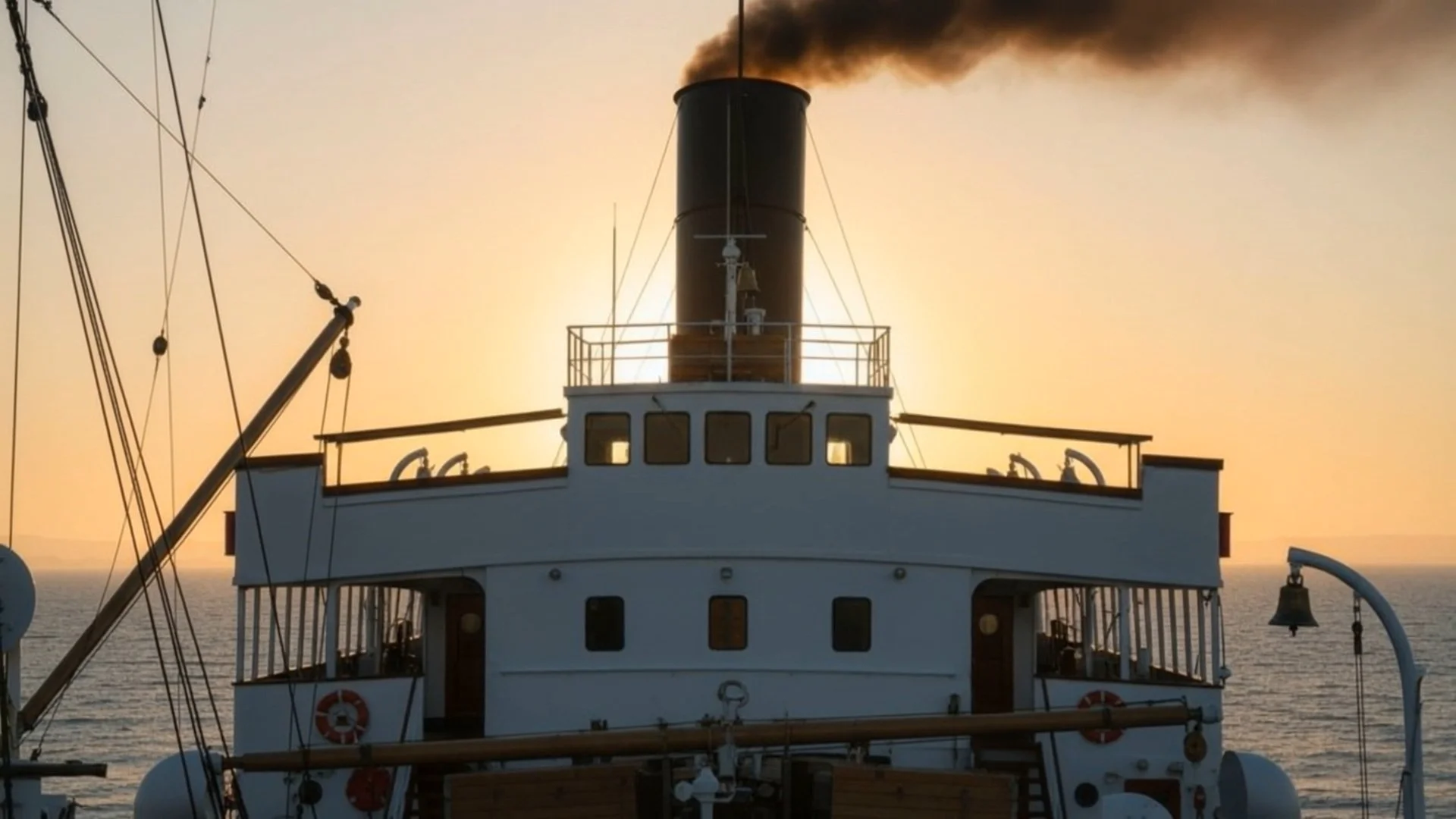
My first tests were minimal: a subtle animation of two photographs. I asked the tool to preserve the grain, the contrast, the degradation of the paper — to keep the image anchored in its material age. The movement was barely perceptible, more breath than gesture. The effect surprised me. It didn’t modernize the image. It allowed me to linger inside it.
That small test shifted the project.
I had three weeks.
Twenty one days to research a ship that barely exists in photographs, to understand a political context that had been largely buried, to study uniforms, fabrics, ship construction, and the geography of a sea still littered with mines months after the war had officially ended.
Most of the research was visual. Through the museum, I accessed archival photographs of the Manuel Calvo taken after the explosion, in dry dock. They show the violence of the impact without drama: the shape of the rupture, the torn steel, the scale of the damage. I read newspaper accounts from the time, sparse and often cautious, shaped by political instability and silence.
Some reconstructions were possible. Others were not.
I attempted to recreate the engine room, working from technical drawings and references to similar steamships. But the results never felt grounded enough. Without sufficient documentation, the images drifted toward speculation. So I discarded them all. Not everything needs to be shown. Absence, when respected, carries its own weight.
The figures that appear in the generated scenes are drawn from the album itself. Faces, silhouettes, uniforms, postures. Where additional characters were needed, I researched the clothing, fabrics, and textures of the period, and placed them only in spaces that could be validated historically. Every image was generated, compared, rejected, refined. The AI did not lead the process. It followed it.
I often say we, out of habit. But this was solitary work. The decisions, the doubts, the refusals — all of them passed through my hands.
The most difficult moment to approach was the explosion itself.
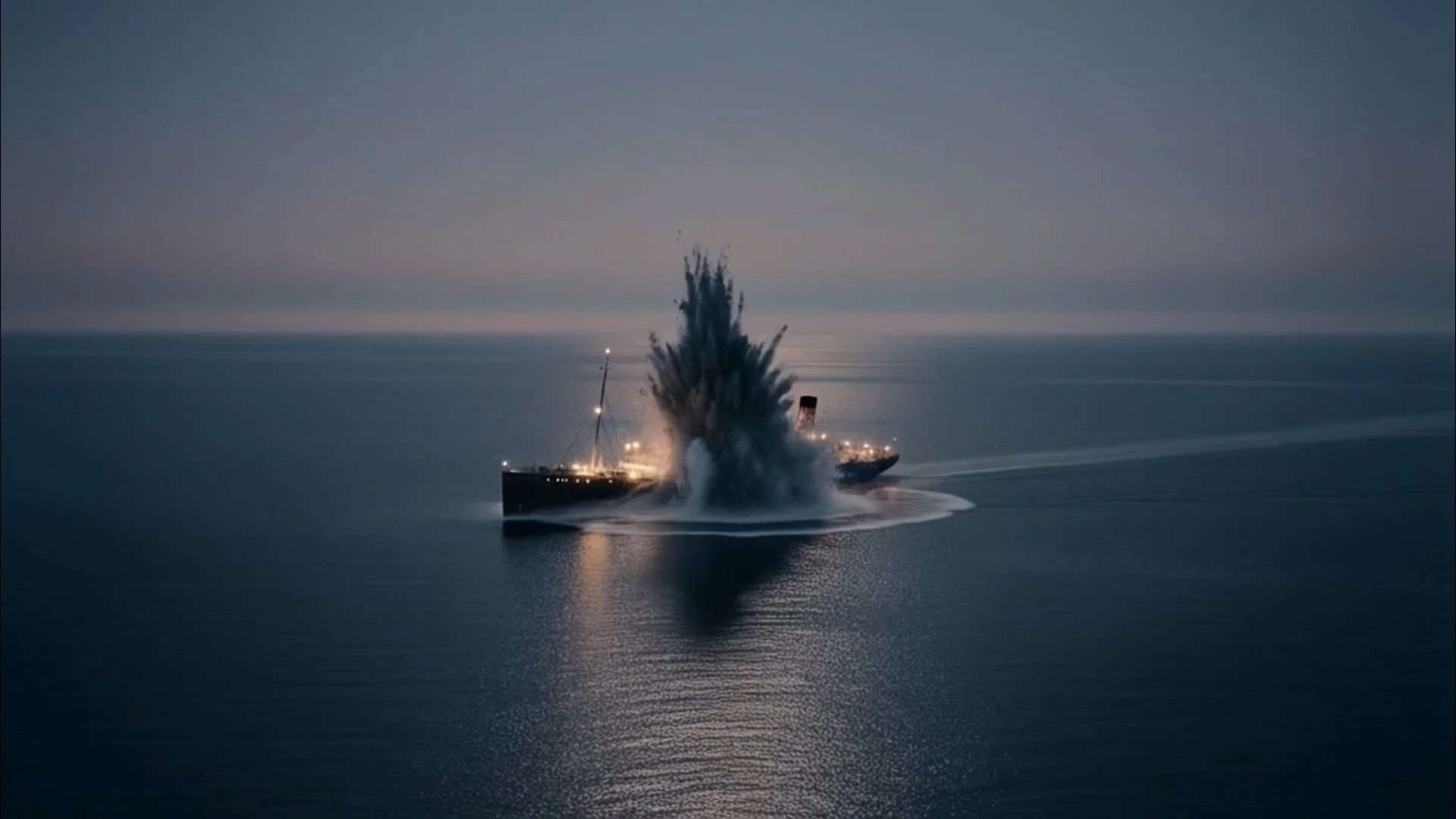
Naval mines do not behave like cinema. Their violence is abrupt, vertical, disorienting. The archival images show the aftermath with painful clarity, but not the moment itself. To ignore it entirely would have been dishonest. To reconstruct it too vividly would have been obscene.
I studied naval engineering texts, documentary footage of underwater explosions, survivor accounts, and the photographs taken after the ship was towed to safety. Dozens of generated attempts were rejected — too dramatic, too clean, too certain.
In the end, I allowed the event to appear only briefly, in two restrained shots. One from a distance: water and smoke rising. One at deck level: confusion, imbalance, fear. No spectacle. No insistence. Not a reconstruction, but an echo.
Sometimes the most ethical way to show something is to let it pass quickly.
The final piece is short — a minute and a half — and silent. It loops in the museum without sound, without instruction. The original photographs remain its core. Everything else exists only to create transitions, to avoid relying solely on parallax, to give rhythm to a story that unfolds in fragments.
The journey it traces is tragic. One hundred and five people died when the Manuel Calvo struck the mine. Those who survived were eventually disembarked in Constantinople and abandoned without protection or support. The ship was repaired. The people were not.
The museum staff have received the piece with care and generosity. They recognize, I think, that the work is not about technological display, but about listening — to an archive, to its silences, to the ethics embedded in what was not photographed.
This project has altered my relationship with generative tools. I no longer see them solely as intrusions, but as instruments that can, under strict guidance, extend the edges of a narrative without pretending to complete it. They have a place in my toolkit now — not as replacements for reality, but as ways of holding its fractures.
My anchor remains the real.
But some stories require a language that can move carefully between what was seen, what was lived, and what had to be left unrecorded.
The camera fell silent because care took over.
Honoring that silence felt like the only place to begin.