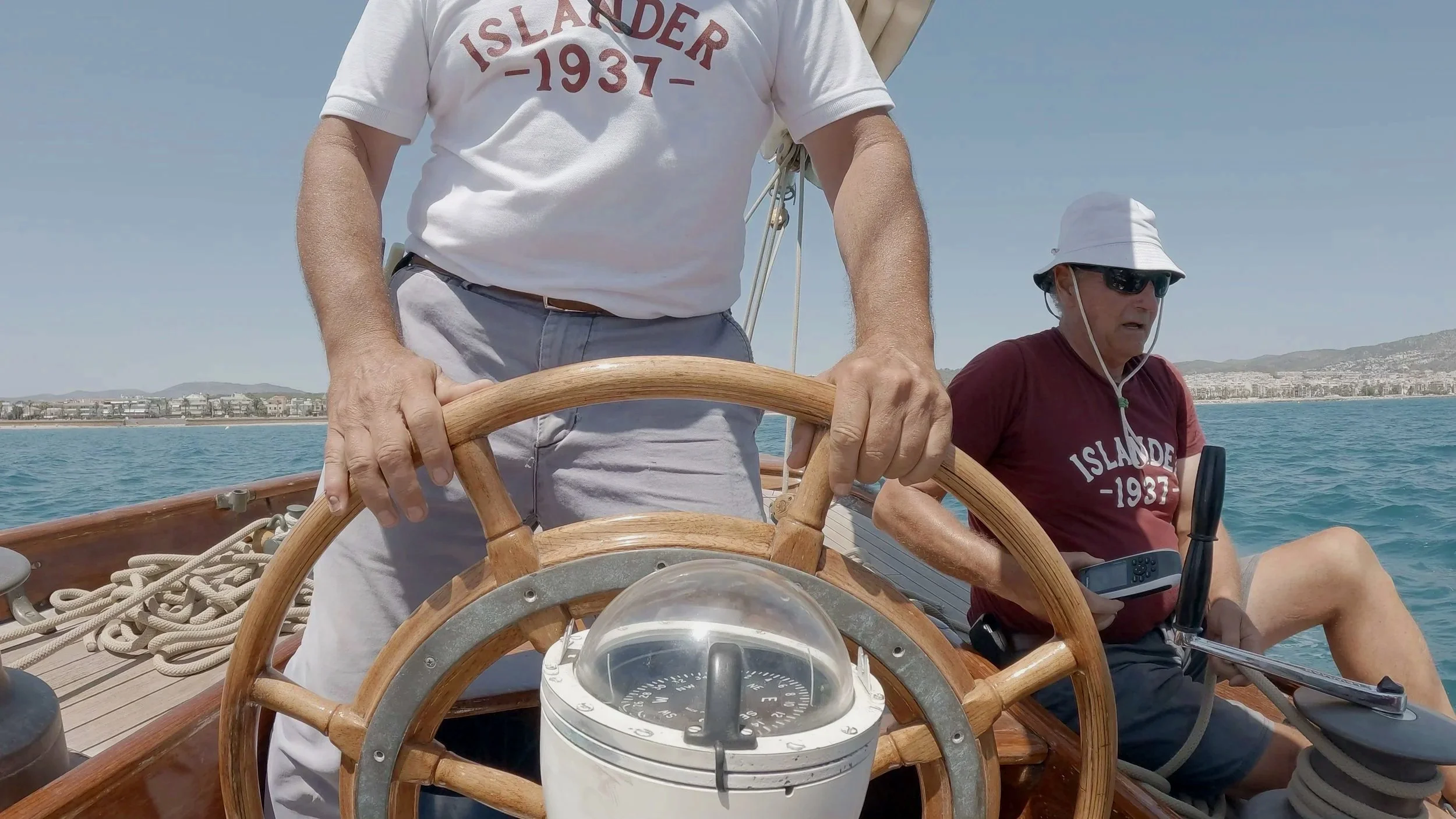
Islander, Invisible Cameras and the Rhythm of Classic Sailing
Last year I spent three days documenting the Sitges Vela Clàssica regatta, shooting both photography and video from aboard several classic sailing yachts and chase boats. The original intention was simple: create a promotional piece for the event and try to capture some of the atmosphere that makes this gathering of classic boats along the Catalan coast so special.
But recently I went back to the material.
And while revisiting the footage, I became increasingly drawn to one specific boat: Islander, a steel sailing yacht built in 1937, captained by Ricardo Albiñana and sailed by an eclectic crew that moved with the kind of calm precision only years at sea can produce.
So I decided to build a new piece entirely around that day onboard.
Not as a regatta recap, but as an exercise.
An attempt to see whether I could create a different kind of sailing film. One that doesn’t observe sailing from the outside looking in, but from inside the movement itself. Embedded in the action, inside the maneuvers, inside the breathing rhythm of the boat and crew.
That distinction matters enormously to me.
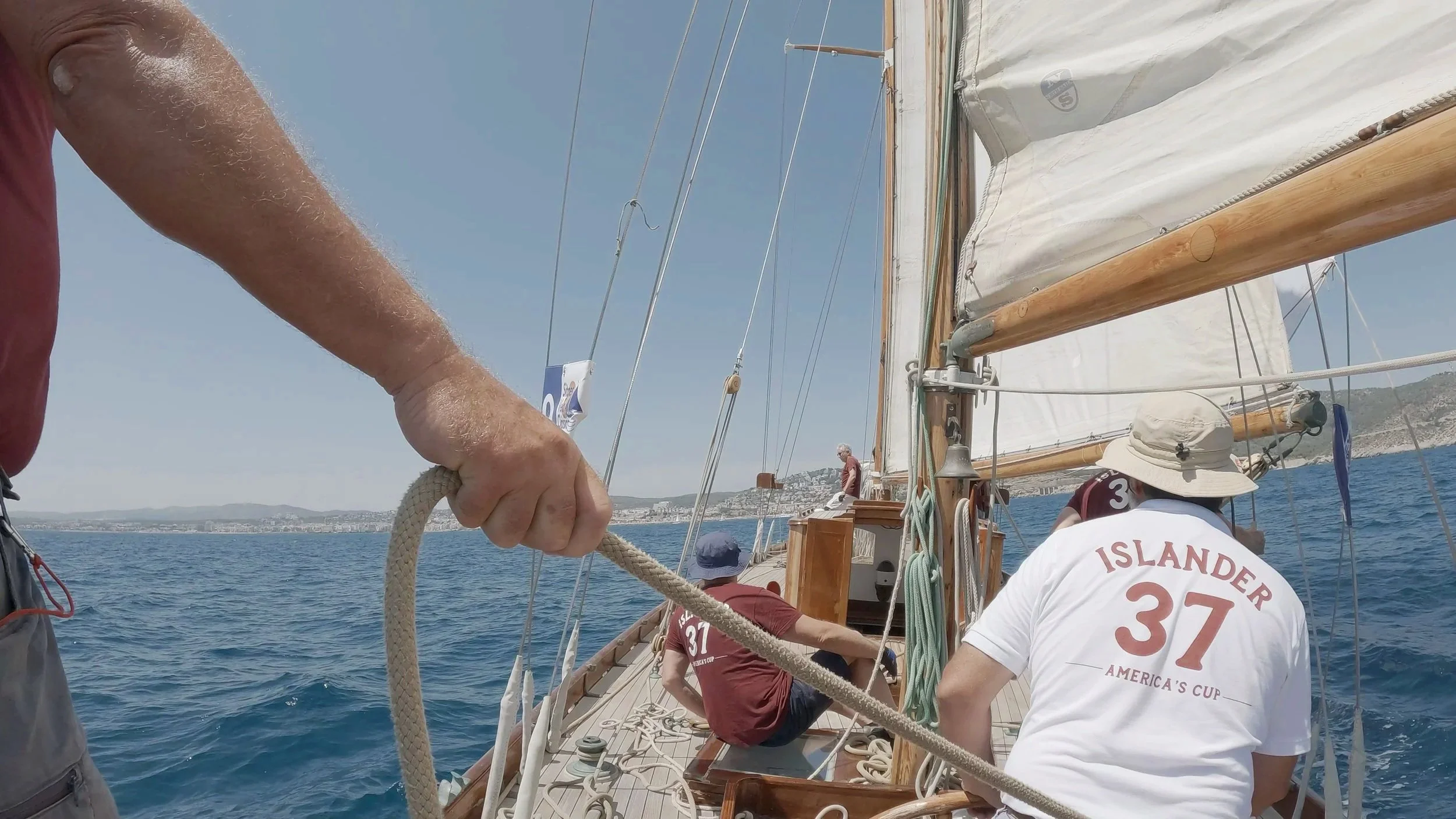
My way of shooting has always depended on proximity. I need to be inside things to understand them. I feel photography and filmmaking less as acts of representation and more as ways of understanding the inner workings of the world around me. The camera becomes a tool for attention. A way of entering systems, rhythms and relationships that often remain invisible from the outside.
And onboard a classic sailing yacht during a regatta, everything becomes a living system.
Even with relatively calm winds, the boat is constantly shifting between tension and release. Everyone onboard has a role. Maneuvers happen quickly. Bodies counterbalance instinctively. Hands move through ropes and sails with memory rather than thought. And in those moments, the worst thing a camera operator can become is an obstacle.
That practical reality was one of the reasons I ended up relying so heavily on the GoPro onboard Islander.
But it also became a narrative decision.
A larger mirrorless camera allows you to play in a completely different visual league: lens choices, compression, texture, depth. But size changes the atmosphere around you. A larger setup occupies space. It interrupts movement. People become aware of it.
The GoPro allowed me to become smaller, faster and almost invisible.
Mounted on a small extension stick, I could place the camera where a larger system simply could not go. Inside a maneuver. Between moving bodies. Under the geometry of sails. Close enough to feel the effort and pressure of the moment without interfering with it.
After years of working with the camera, I know exactly what the lens sees before I even raise it. I know the field of view instinctively. That familiarity creates freedom onboard.
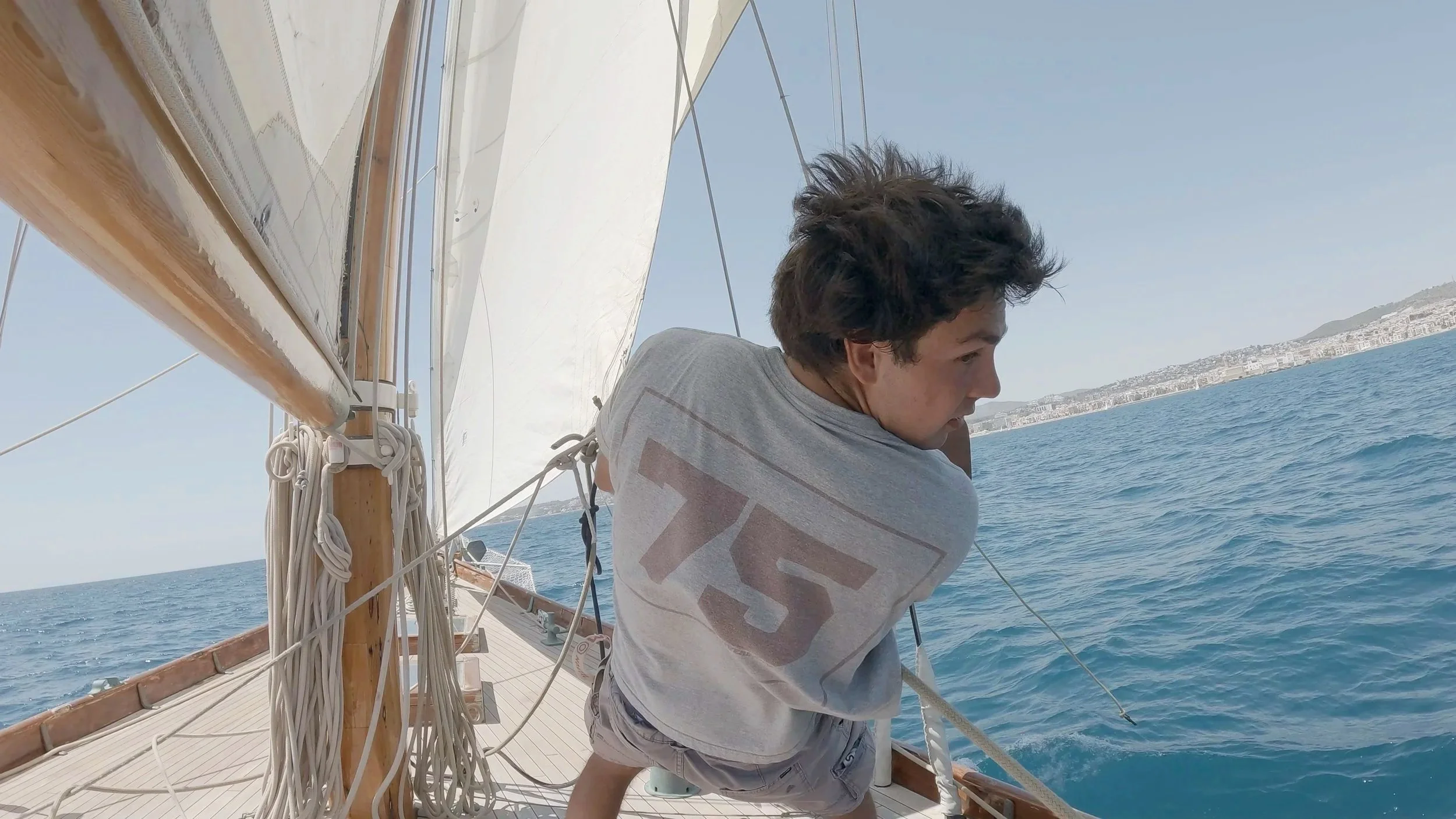
What interests me, however, is not the typical action-camera language usually associated with the GoPro. I’m not interested in hyperactive cuts, distorted ultra-wide perspectives or spectacle for its own sake. Most of the footage in this piece was shot in Linear mode, searching for a cleaner geometry and a perspective closer to a 24 or 35mm lens.
Sometimes I wish the GoPro could actually accept real lenses while maintaining its tiny form factor. But during shoots like this, its limitations become part of its strength. Even with the electronic correction and crop applied in Linear mode, the camera gives me something invaluable: the ability to disappear.
And disappearing matters.
I am very conscious onboard of not looking like a camera operator. My job is to stay out of the way. To merge into the atmosphere until the crew no longer feels observed.
That trust changes everything.
The footage stops feeling captured and starts feeling lived.
What still surprises me now, revisiting the material a year later, is discovering how often the shots carried exactly the feeling I had imagined while placing the camera there in the first place.
Not technically.
Emotionally.
And maybe that is ultimately what I keep searching for through photography and filmmaking: not simply recording what happened, but preserving, somehow, what it felt like to be there.